Remembering Yourself

A Heart-Centered Journey Home

Two Suns Rising ยท Companion to Our Greater Brain

The Map in Our Brain

Every part of us has a place on the brain's surface, and practice makes that place grow.

Across the top of the brain run two narrow strips. One feels touch, the other moves the body, and each holds a full map of us from toes to tongue. Drawn to the size of its share of that map, the body becomes this strange little figure: the homunculus.
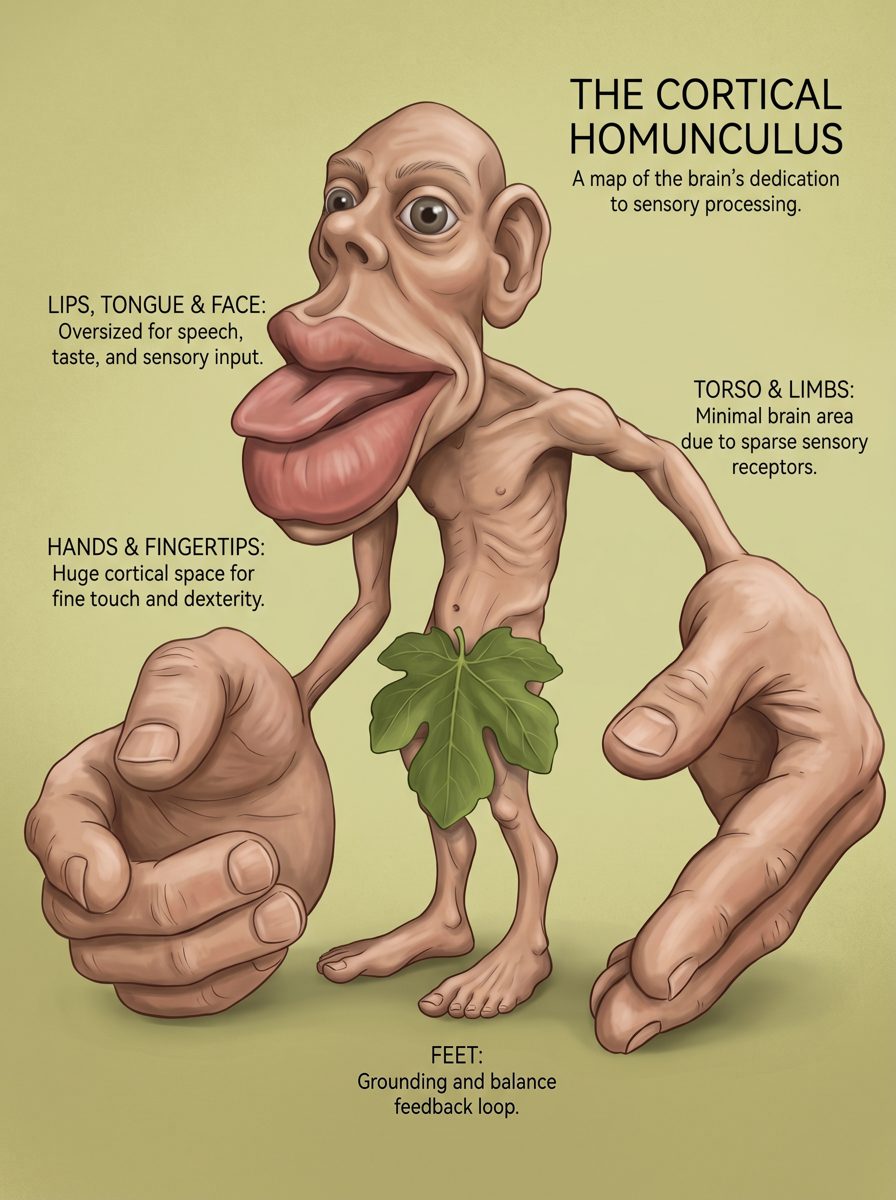
The cortical homunculus: a figure with enormous hands, lips and tongue, a thin torso and limbs, and ordinary feet, drawn to show how much brain area each body part receives
The sensory homunculus. Each body part is drawn to the size of the brain area that feels it.

Reading the figure

Hands and fingertipslargest share of the touch map after the face

Our hands get a huge stretch of brain, because they are packed with touch sensors and make the finest movements we have.

  • Each fingertip has its own patch of cortex. The thumb and index finger get the most.
  • That is why we can feel a hair under paper with a fingertip, and not with our back.
  • In our practice the palm is the part that meets the energy field. Leading with the hands draws on one of the richest regions of the map.
Lips, tongue and facethe largest share of all

Speech, taste, swallowing and expression need fine control and fine feeling, so the mouth and face take the biggest part of both maps.

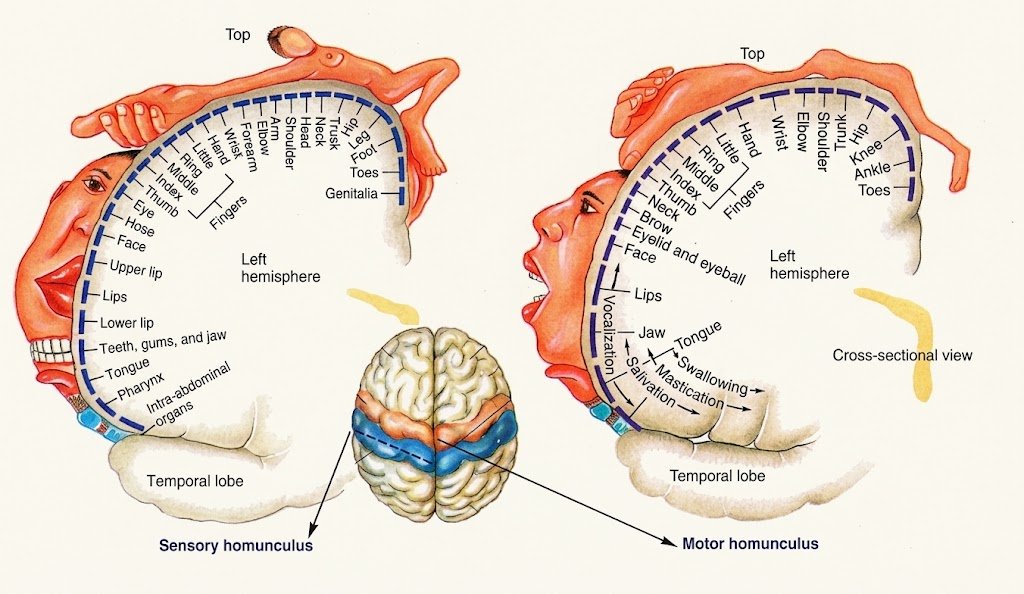
  • The motor map gives whole regions to vocalization, swallowing and chewing.
  • This is the territory of the throat center, Heron Rising Song: voice and breath pass through a part of us the brain watches very closely.
Torso and limbssmall on the map

Our trunk, arms and legs have far fewer touch sensors, so the brain gives them very little room. We feel them only roughly.

  • Five of our seven centers sit along the torso: root, belly, solar plexus, heart and throat.
  • That is one reason they are easy to forget. The brain's map of them is faint until we give them attention.
  • Practice is how we fill in that faint part of the map.
Feetgrounding and balance

The soles report every shift of weight. On the map the feet and toes sit at the very top of the strip, right beside the genitals.

  • That closeness of feet and pelvis on the map mirrors the root center, which runs from the pelvic floor down through the legs and feet into the ground.
  • Bear Resting spreads the weight evenly across both feet, front and back: a steady stream of information into that part of the map.
The map can growneuroplasticity

The map is not fixed. Parts we use with attention take up more room; parts we neglect shrink back.

  • Violinists and other string players have a larger map for the fingers of the left hand, the hand that finds the notes. The earlier they started, the larger it is.
  • Braille readers show an enlarged map for their reading finger.
  • The pattern is consistent: repeated movement done with attention grows the brain's map of that part of us. That is BUILD, the first step of our practice.

Where the map lives

The two strips run from ear to ear across the top of the head, just in front of and behind the central groove of the brain. The sensory strip (blue) feels; the motor strip (orange) moves. Neurosurgeon Wilder Penfield traced both maps in the 1930s and 1940s by gently stimulating the brain surface in awake patients and asking what they felt.

Cross-sections of the sensory and motor strips of the left hemisphere, each labeled with body parts from toes at the top to tongue and throat at the bottom, with a top view of the brain showing where the two strips lie

What this means for our practice

The homunculus shows how the brain sees us now. Practice changes the drawing. See how the seven centers rest on the wider nervous system in Our Greater Brain.